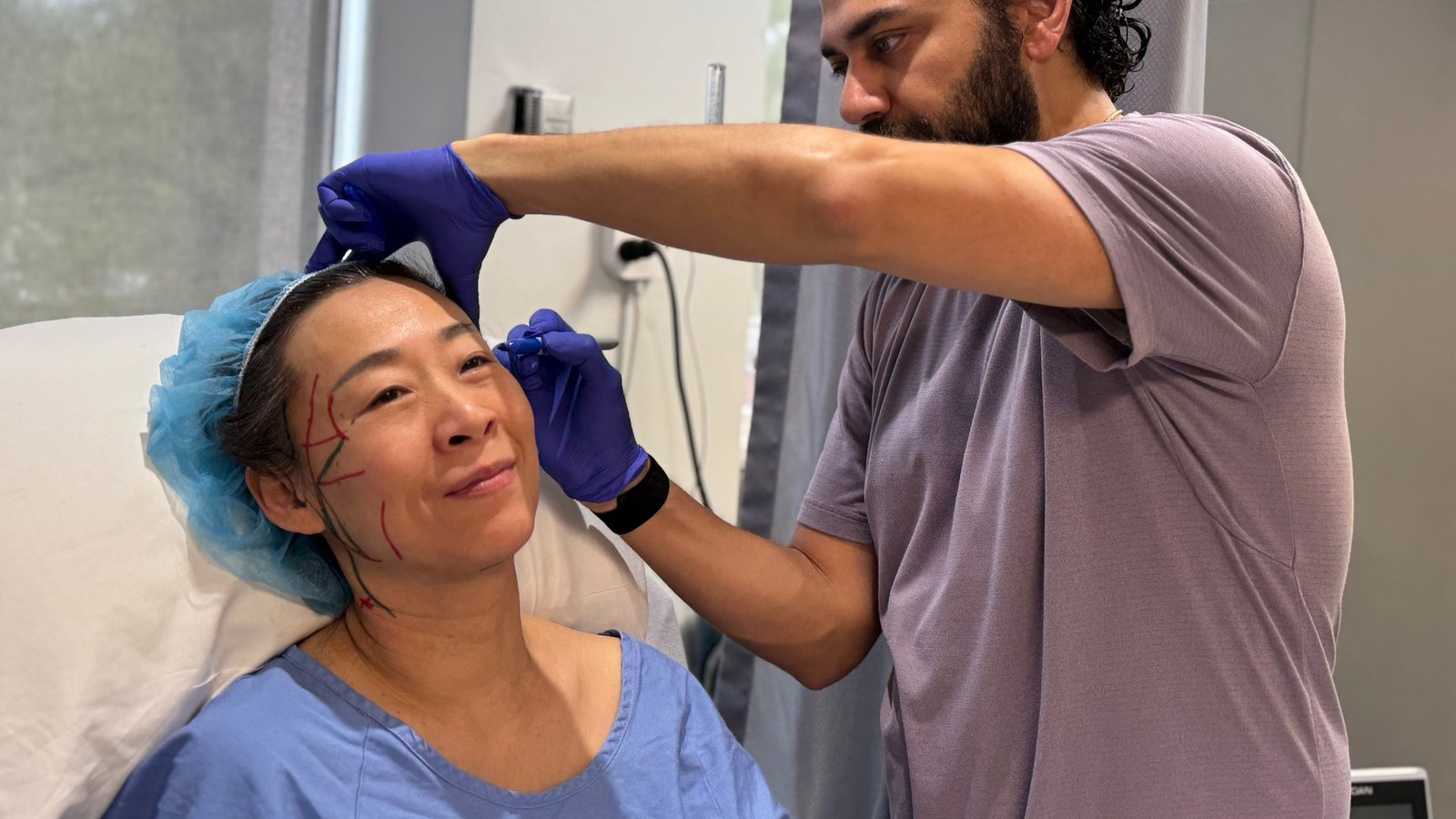
Dr Moubayed is an otolaryngologist – head and neck surgeon practicing facial plastic surgery in Montreal for about ten years. In his view, three things help you know whether a facelift can be considered. None of them replaces a consultation, but they help you see things more clearly before taking the first step.
1. Your facial aging bothers you
The first criterion is personal. Seeing your face age has to bother you, and you have to want to do something about it. Many people are perfectly comfortable with the way their face ages, and that is completely fine. Others want to act.
Dr Moubayed compares this decision to other personal choices: some people like to wear hair gel, some like to wear makeup, some prefer red and others blue. Wanting to address facial aging, safely, is the same kind of preference. There is no right or wrong answer: the starting point is what you want, not what someone else thinks you should do.
Current techniques, such as the deep plane facelift, aim for a natural-looking result. Like any surgery, a facelift carries risks, which are explained in detail during the consultation.
2. You see visible signs of laxity
The second criterion is anatomical: there must be visible signs of aging, mainly laxity of the tissues. The face ages from the top down, and Dr Moubayed explains why.
The role of collagen and elastin
With age, the skin contains less collagen and less elastin. We lose roughly 1% per year starting in our thirties. Collagen keeps tissues from stretching. Elastin allows tissues to spring back after being stretched: under the microscope, these are tiny protein fibres that look like little coils. Less collagen, and tissues stretch more easily; less elastin, and they snap back less easily.
The effect of gravity
Then there is gravity, which pulls everything down. As the tissues of the face descend, several signs appear:
- a deeper hollow under the eyes;
- deeper nasolabial folds;
- jowls along the jawline;
- marionette lines at the corners of the mouth;
- platysmal bands, the descent of the muscle in the neck.
These signs of laxity are what a face and neck lift can correct. For the neck, we often talk about a neck lift, done alone or together with a facelift.
What surface treatments can and cannot do
Dermal fillers, lasers and other superficial techniques work on the skin. They help maintain a bit of collagen and elastin. But laxity in the deeper tissues can only be addressed by physically moving those tissues back where they belong. That is the role of a facelift.
3. Your health allows it
The third criterion is medical: you need to be healthy enough. A facelift is elective aesthetic surgery, and the team does not offer it to someone who is too sick. According to Dr Moubayed, most healthy people under 70 can qualify.
Age is not the only factor. A 45-year-old can have serious heart or lung problems that make surgery inadvisable. On the other hand, as we get older, tissues heal differently and more slowly, and some health problems, such as kidney or heart issues, can be present without the person knowing. That is why the team usually draws the line at about 70.
Assessing your health is part of the consultation: medical history, medications, lifestyle and, when needed, additional tests. This step is not a formality. It is what allows the team to plan surgery safely, or to recommend waiting or choosing another option when that is the wiser choice for you.
In short
You may be a good candidate for a facelift if:
- your facial aging bothers you and you want to act;
- you see signs of laxity: hollows under the eyes, folds, jowls, a loose neck;
- you are in good health, usually before about age 70.
Only a consultation can confirm whether a surgical facelift is right for you, and which one. Risks, recovery and other options are also discussed.
Wondering if it is for you? Book a free 30-minute discovery call with the Clinique Face MD team. The place for my face.