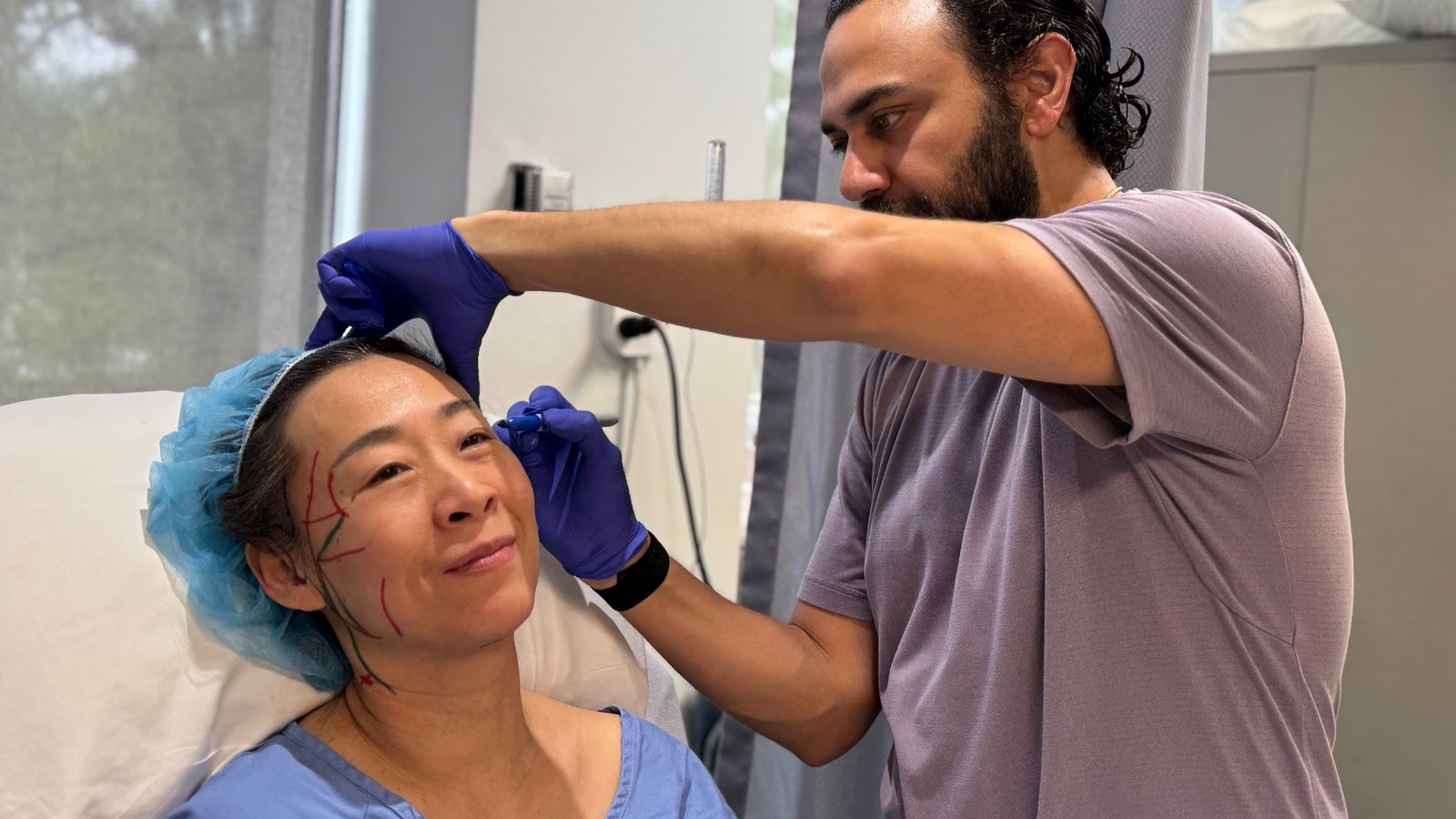
Dr. Moubayed is an otolaryngologist – head and neck surgeon practicing facial plastic surgery in Montréal. He performs facelifts, including the deep plane facelift, which works in the deep layers of the face and neck, in both men and women. The core technique is the same, but some details change when the patient is a man.
More blood vessels under the skin
The first major difference is vascular. In men, the skin of the face and neck contains more small blood vessels. This network just under the skin is called the vascular plexus, and the difference is largely related to testosterone, a hormone that is more present in men.
As Dr. Moubayed explains, more vessels inevitably means a little more bleeding during surgery. To see clearly, the surgical field has to stay clean, so the surgical team spends more time controlling each of these small bleeding points.
Surgery that takes more time
Controlling bleeding has a name in surgery: hemostasis. It is a meticulous step, whether the surgeon is working on the face or the neck, and in men it simply takes longer.
In practice, a facelift in a man often takes a little longer to perform than in a woman. That extra time is not a detail; it is part of the care that goes into the procedure. Careful hemostasis is one of the factors that help limit bleeding-related complications after surgery, such as a hematoma, although it cannot eliminate them completely.
The beard and incision placement
The second difference is facial hair. Most men have hair on the cheeks and lower face, whether or not they wear a beard. During a facelift, the skin is repositioned backward and upward, and the incisions are closed around the ear. If this is not planned for, beard-bearing skin can end up very close to the ear, or even on the cartilage.
Dr. Moubayed often lets the patient choose where the scar in front of the ear will sit:
- In front of the ear cartilage: for a man who wears a beard, this avoids bringing hair-bearing skin into the ear.
- Behind the small cartilage at the front of the ear: the scar is better hidden, but hair-bearing skin is brought closer to the ear. Laser hair removal or electrolysis can then be done to remove that hair.
“It’s really a discussion I have with the patient while we are drawing the incision. It’s really the patient who chooses,” says Dr. Moubayed. If you are interested in that option, laser hair removal can be planned once healing is complete.
CO2 laser over the beard area
The third difference concerns resurfacing. A CO2 laser is often combined with a facelift to improve skin texture and quality. In men, the question is whether to treat the beard area.
In theory, the CO2 laser acts on the superficial layers of the skin and does not directly reach the hair follicle, the bulb at the root of the hair. However, the heat produced by the laser spreads into the tissue. If a little more heat reaches the follicles, it could in theory reduce their activity, or sometimes destroy them. The possible result is a slightly thinner beard in the treated area.
Here again, Dr. Moubayed leaves the choice to the patient: treat the beard area or not. Some men prefer to keep their beard intact; others accept that it may be a little less dense.
Key takeaways
The main principles of a facelift are the same for everyone. For men, you mainly need to plan for:
- a slightly longer operation, because of the time spent on hemostasis;
- a discussion about incision placement in relation to the beard;
- a decision on whether or not to treat the beard area with CO2 laser.
Like any surgery, a facelift carries risks, and results vary from person to person. A consultation lets the team examine your face and neck, discuss your goals and choose with you the technique and scar placement that suit you. To learn more about the techniques, see our page on facelift in Montréal.
Thinking about a facelift? Book a free 30-minute discovery call with our team. Clinique Face MD, the place for my face.