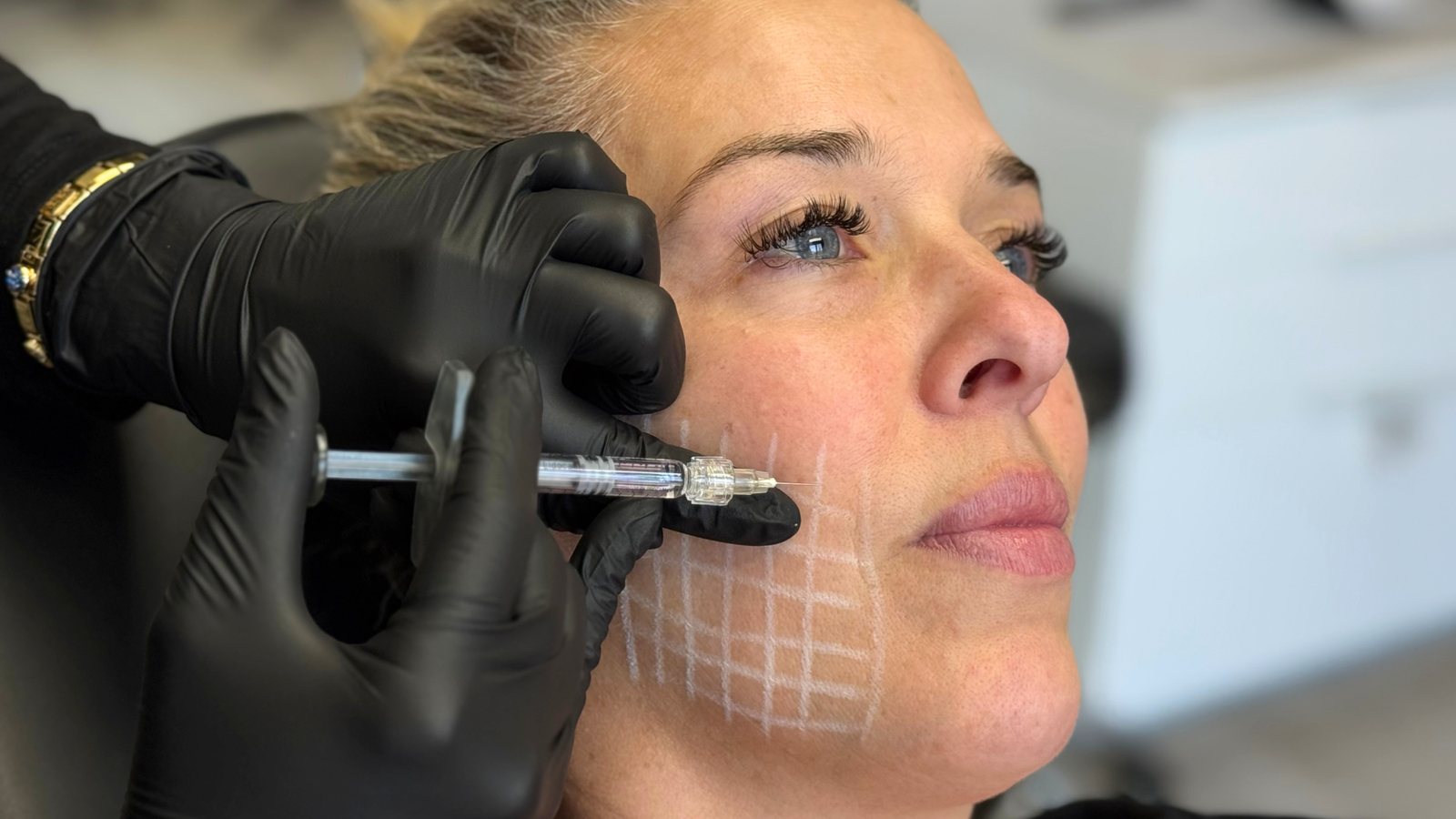
Dr Moubayed is an otolaryngologist – head and neck surgeon practicing facial plastic surgery in Montreal. When people think about facial rejuvenation, they usually think about wrinkles, volume or sagging. Yet well-hydrated skin looks more radiant and supple, and fine lines are less visible. That is what skinboosters focus on.
What the skin loses with age
From around age 30, the skin loses roughly 1% of its collagen every year. It also loses about 1% of its hyaluronic acid per year. These two losses add up over time and change the quality of the skin.
Hyaluronic acid is a molecule naturally present in the skin. Its key property: it holds several times its weight in water. As Dr Moubayed puts it, it can hold about five times its weight in water. When the amount decreases, the skin holds less water, and it shows:
- the skin loses its glow and looks duller;
- fine lines become more noticeable;
- texture becomes less even;
- the skin looks less plump.
On the other hand, skin that is well hydrated in depth has more glow and a fuller look, without changing your features.
Why a cream is not enough
A common question: doesn’t a good moisturizer do the same job? According to Dr Moubayed, no. A cream hydrates the surface of the skin. It has its place in a daily skincare routine, along with sunscreen, but it does not reach the deeper layers where hyaluronic acid is lost with age.
That is why, in his view, hydration is the most neglected part of facial rejuvenation. People invest in surface products, while the loss happens deeper. To act at that level, you need an approach that brings hydration directly into the skin.
Skinboosters: injected hydration
Skinboosters are injections of non-cross-linked hyaluronic acid, placed superficially in the skin. Non-cross-linked means the product is more fluid than the one used to add volume. Its role is not to fill a hollow or change a contour, but to rehydrate the skin from within.
How the treatment works
The protocol Dr Moubayed describes is simple:
- about two syringes for the whole face;
- three sessions, one month apart;
- very small injections spread all over the face.
The product does not add volume. It hydrates. This is an important difference from dermal fillers, which are used to restore or sculpt volume. The two approaches can complement each other, but they do not meet the same need.
What to expect
Before treatment, the face is examined and the areas to treat are marked. Injections are quick, and a numbing cream can be applied to make the session more comfortable. Most people resume their usual activities soon after, though small marks may be visible for a few days.
The goal is more radiant, better-hydrated skin with less visible fine lines. Effects vary from person to person, depending on skin quality, age and lifestyle. Maintenance is usually discussed in consultation, since the skin keeps losing hyaluronic acid over time.
Another option: microneedling and exosomes
Skinboosters are not the only way to improve skin hydration. The other approach the team favours is microneedling combined with exosomes. Microneedling creates tiny channels in the skin and stimulates collagen, while exosomes applied during the session aim to support skin quality.
At the clinic, these two treatments are the ones the team uses most often for hydration. Choosing between them, or combining them, depends on your skin, your goals and how you tolerate treatments. That is exactly what the consultation helps determine.
Risks and consultation
Like any injectable treatment, skinboosters carry risks: redness, swelling, tenderness, small temporary bumps or bruising at the injection points, and more rarely infection or a reaction to the product. Microneedling can also cause redness and sensitivity for a few days. These points, contraindications and aftercare are explained in detail in consultation, where a health professional assesses your skin before recommending an option.
In summary
- From age 30, the skin loses about 1% of collagen and 1% of hyaluronic acid per year.
- Hyaluronic acid holds several times its weight in water: the less there is, the less hydrated the skin.
- A cream hydrates the surface, but not in depth.
- Skinboosters rehydrate the skin without adding volume: about two syringes, over three sessions one month apart.
- Microneedling with exosomes is another option to improve skin quality.
Would you like to know which option suits your skin? Book a free 30-minute discovery call with the Clinique Face MD team. La place pour ma face.