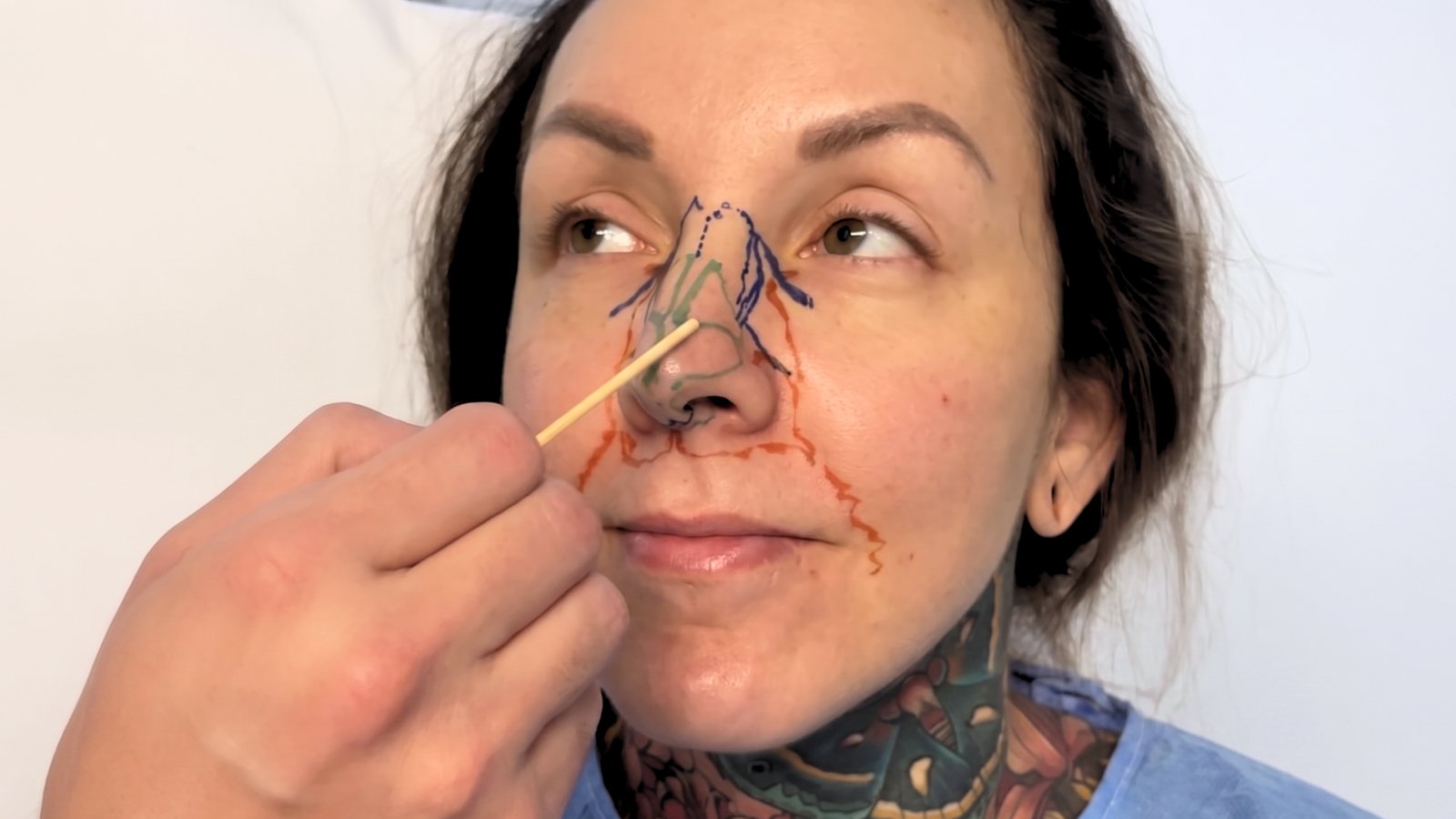
Dr Moubayed is an otolaryngologist – head and neck surgeon practicing facial plastic surgery in Montreal. The question “am I a candidate?” often comes up before a first consultation. His answer comes down to three criteria: the shape of your nose bothers you, there is something concrete to change, or you have trouble breathing through your nose. Here is what each one means.
1. The shape of your nose bothers you
The first criterion, and the most important, is that your nose bothers you. This can take several forms:
- your nose is a distraction when you look at yourself in pictures;
- it affects your self-esteem;
- it makes your face look more severe;
- it does not match the rest of your features;
- it makes you feel your face looks older.
If it is something that bothers you, you meet the first criterion. On the other hand, as Dr Moubayed puts it, if your nose does not bother you, you are not a candidate. The decision starts with you, not with an outside standard or someone else’s opinion. A rhinoplasty is a personal choice, and it should answer something that matters to you.
2. There is something that can be changed
The second criterion is anatomical. There has to be something the team can actually work on. If a nose is already harmonious, there is nothing to operate on. The features that can be modified are many:
- a hump on the bridge, the most common reason;
- a droopy tip;
- a deviated nose;
- a nose that is too wide;
- a bridge that is too low or too high;
- a tip that is too boxy or too bulbous.
Current techniques, including ultrasonic rhinoplasty, make it possible to modify a wide variety of nose shapes and aesthetic concerns. The goal is a nose that is in harmony with your face. The plan is always personalized, and the consultation is where the team determines what can be changed, what should be changed and what is better left as is.
See it before you do it
To help you picture the change, the team can use SimFaceMD, a simulation app: see it before you do it. A simulation supports the discussion; it is not a promise of results.
3. You have trouble breathing through your nose
The third criterion is about function. If you are not getting enough air through one or both nostrils, and you would like to improve the look of your nose at the same time, or at least preserve its aesthetics as much as possible, you could be a candidate for rhinoplasty.
This is then called a septorhinoplasty, because the surgery addresses both function, meaning breathing, and aesthetics. Dr Moubayed is an otolaryngologist, so assessing breathing is a natural part of how he examines the nose.
How the assessment works
In consultation, the nose is examined from the outside and the inside. The team looks at its shape, its proportions relative to the rest of the face, the skin quality and the cartilage structure. The septum and the airflow through each nostril are also checked. You can then discuss your expectations, what is realistic in your case and the stages of recovery. It helps to bring photos that show what bothers you, and to write down your questions ahead of time.
Risks and consultation
Like any surgery, rhinoplasty carries risks: swelling, bruising, bleeding, infection, asymmetry, breathing difficulty or the need for a touch-up. Recovery takes time, and the final result is judged over several months. These points are explained in detail in consultation, along with the options that fit your situation, including when a revision rhinoplasty is being considered.
In short
You may be a good candidate for rhinoplasty if:
- the shape of your nose bothers you;
- there is something concrete to change: a hump, the tip, a deviation, the width;
- you have trouble breathing through your nose and also want to improve or preserve its appearance.
Do you recognize yourself in one of these criteria? Book a free 30-minute discovery call with the Clinique Face MD team. The place for my face.