
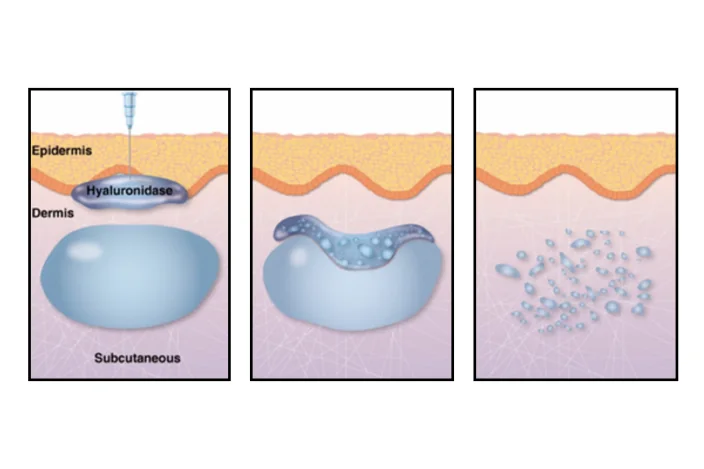
The use of hyaluronic acid for facial volume restoration is a common procedure in aesthetic medicine. While most treatments provide satisfactory outcomes, there are instances where the displacement of the product or over-correction necessitates an intervention. Understanding the scientific process of dissolving these fillers is essential for patients seeking to adjust or correct previous procedures. This clinical overview explains how a specialized enzyme is used to manage these outcomes.
At Clinique Face MD, all corrective procedures are performed by a Head and Neck Surgeon practicing in Facial Plastic Surgery or a GP practicing in Aesthetic Medicine. This specialized oversight ensures that any corrective step is taken with a thorough understanding of facial anatomy and tissue response.
The Role of Hyaluronidase in Aesthetic Correction
Hyaluronidase is a naturally occurring enzyme that specifically breaks down the bonds within hyaluronic acid molecules. In a clinical setting, a concentrated form of this enzyme is injected directly into the area where the filler is no longer desired. This may occur due to product migration, nodules, or an aesthetic result that does not harmonize with the patient’s facial structure.
Factual Considerations for the Procedure
- Onset of Action: The enzyme begins to break down the product immediately upon contact, with the most significant changes occurring within the first 24 to 48 hours.
- Precision Injection: The effectiveness of the dissolution depends on the precise placement of the enzyme within the same anatomical plane as the original filler.
- Metabolization: Once the hyaluronic acid is broken down into simpler sugars, the body naturally absorbs and eliminates the components through the lymphatic system.
Clinical Indications for Dissolving Fillers
There are several documented reasons why a patient or a physician may decide to dissolve existing filler. These decisions are based on objective clinical findings rather than subjective dissatisfaction alone.
- Product Migration: When the filler moves from its original injection site into an adjacent area, such as above the lip border or below the tear trough.
- The Tyndall Effect: A bluish discoloration of the skin that can occur when filler is placed too superficially, causing light to scatter.
- Asymmetry or Over-correction: Instances where the volume added creates an imbalance in facial proportions or interferes with natural muscle movement.
- Vascular Safety: In rare cases where product interferes with local blood flow, the immediate use of the enzyme is a necessary medical protocol.
Safety and Professional Standards
The administration of hyaluronidase is a medical act that requires a comprehensive understanding of head and neck anatomy. A Head and Neck Surgeon practicing in Facial Plastic Surgery possesses the anatomical training required to map the location of the misplaced product and deliver the enzyme safely, avoiding vital structures.
Furthermore, a GP practicing in Aesthetic Medicine ensures that the patient’s medical history is reviewed for potential allergies to the enzyme, ensuring that the corrective process adheres to the highest standards of the profession. This factual approach prioritizes patient safety and the restoration of natural facial contours.
The Importance of a Consultation
Every face is unique, and the decision to dissolve or adjust a filler treatment must be made following a physical examination. During a consultation, the physician will assess the type of filler used, the depth of its placement, and the integrity of the surrounding tissue to create a verifiable plan for correction.
MEDICAL DISCLAIMER: The information provided in this article is for educational purposes only and is not a substitute for professional medical advice, diagnosis, or treatment from a qualified healthcare practitioner. Always seek the advice of a physician or other qualified health provider with any questions you may have regarding a medical condition or procedure.To schedule a diagnostic assessment and discuss a clinical treatment plan, book your consultation today.