
Hair loss is a progressive journey, but for many men, it can feel like an unpredictable shift in their appearance. Understanding how hair loss develops is the first step toward reclaiming control over your profile. In the world of hair restoration, the universal language used to describe this progression is the Norwood Scale. This classification system allows both patients and specialists to identify the current stage of thinning and, more importantly, determine the most effective biological and surgical interventions. At our practice, we utilize the Norwood Scale to create precise, anatomical roadmaps for our patients. By identifying exactly where you fall on this scale, we can move away from one-size-fits-all solutions and focus on the specific structural needs of your hairline and crown.
What is the Norwood Scale?
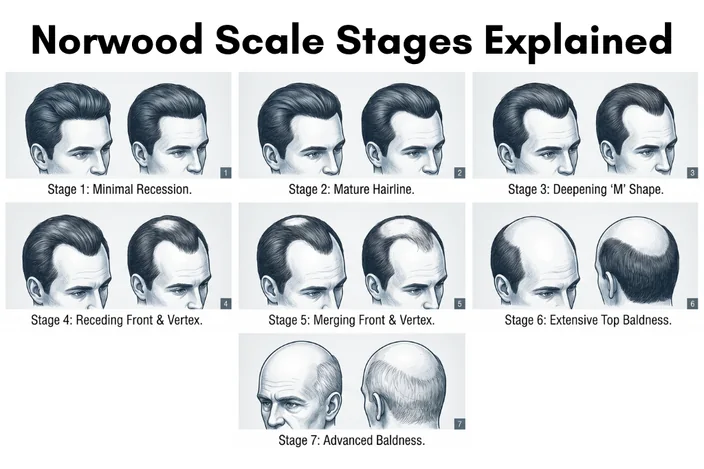
The Norwood Scale, or the Hamilton-Norwood Scale, is a seven-stage classification system used to measure the extent of male pattern baldness (androgenetic alopecia). Developed in the 1950s by Dr. James Hamilton and refined in the 1970s by Dr. O’Tar Norwood, it remains the gold standard in clinical hair restoration. The scale serves three primary purposes: it tracks the biological progression of hair loss, provides a baseline for estimating the number of grafts needed for a hair transplant, and helps specialists recommend the correct timing for medical versus surgical treatments.
The 7 Stages of the Norwood Scale
Stage 1: Minimal Changes
At this stage, the hairline is still intact with no visible recession. While there is no current balding, this is the ideal time for individuals with a family history of hair loss to establish a baseline. Monitoring the hair density at the temples and crown during Stage 1 allows for the earliest possible intervention.
Stage 2: The Mature Hairline
Stage 2 is characterized by a slight recession at the temples, often creating a mild M shape. This is frequently referred to as a mature hairline. While not yet classified as active balding, it is the stage where many men begin to notice their forehead appearing slightly higher. Preventive medical therapies are highly effective at this point.
Stage 3: The Turning Point
Stage 3 is officially considered the first stage of clinical hair loss. The recession at the temples becomes deep and clearly visible. In the Stage 3 Vertex variation, the hairline recedes, but a distinct thinning spot also appears at the crown. This is the stage where most patients begin researching professional restoration options.
Stage 4: Pronounced Recession
At Stage 4, the recession at the temples is severe, and the bald spot on the crown is larger. However, a solid band of hair still separates the receding hairline from the thinning vertex. At this level, medical management is often combined with surgical planning to restore density.
Stage 5: The Narrowing Bridge
The bald areas at the front and the crown continue to enlarge. The bridge of hair that once separated them becomes very narrow and thin. The horseshoe pattern of hair around the sides and back remains, but the top of the head is showing significant scalp visibility.
Stage 6: The Bridge Disappears
Stage 6 occurs when the bridge of hair across the top of the head is completely lost. The frontal and crown balding areas merge into one large region. While surgical restoration is still possible, it requires a strategic distribution of donor hair to cover a much larger surface area.
Stage 7: Advanced Thinning
This is the most advanced stage of the Norwood Scale. Only a thin ring of hair remains around the back and sides of the head. In Stage 7, the remaining hair is often finer or less dense. Restorative goals at this stage usually focus on creating a natural frame for the face rather than full-head density.
Medical vs. Surgical Intervention
The Norwood Scale acts as a guide for treatment timing. For patients in Stages 1 through 3, the focus is often on stabilization and the preservation of existing follicles. Medical-grade topicals, oral supplements, and regenerative treatments like Platelet-Rich Plasma (PRP) can help thicken the miniaturized hairs that are starting to thin, effectively slowing the clock on the next stage by utilizing the body’s own growth factors to stimulate the scalp. For patients in Stages 4 through 7, the structural framework of the hairline has often shifted significantly. In these cases, surgical restoration—such as follicular unit extraction—is the most effective way to rebuild a natural, permanent hairline.
Precision and Professional Assessment
While the Norwood Scale is a powerful tool for self-assessment, it is not a substitute for a professional anatomical evaluation. Hair loss can be influenced by multiple factors, including genetics, blood flow, and scalp health. A diagnostic consultation allows us to look beyond the scale and analyze the health of your donor hair and the quality of your scalp tissue. Our commitment to surgical integrity means we only recommend procedures when the timing is biologically appropriate.
MEDICAL DISCLAIMER: The information provided in this article is for educational purposes only and is not a substitute for professional medical advice, diagnosis, or treatment from a qualified healthcare practitioner. Always seek the advice of a physician or other qualified health provider with any questions you may have regarding a medical condition or procedure.To schedule a professional hair assessment and determine your stage on the Norwood Scale, book your consultation today.