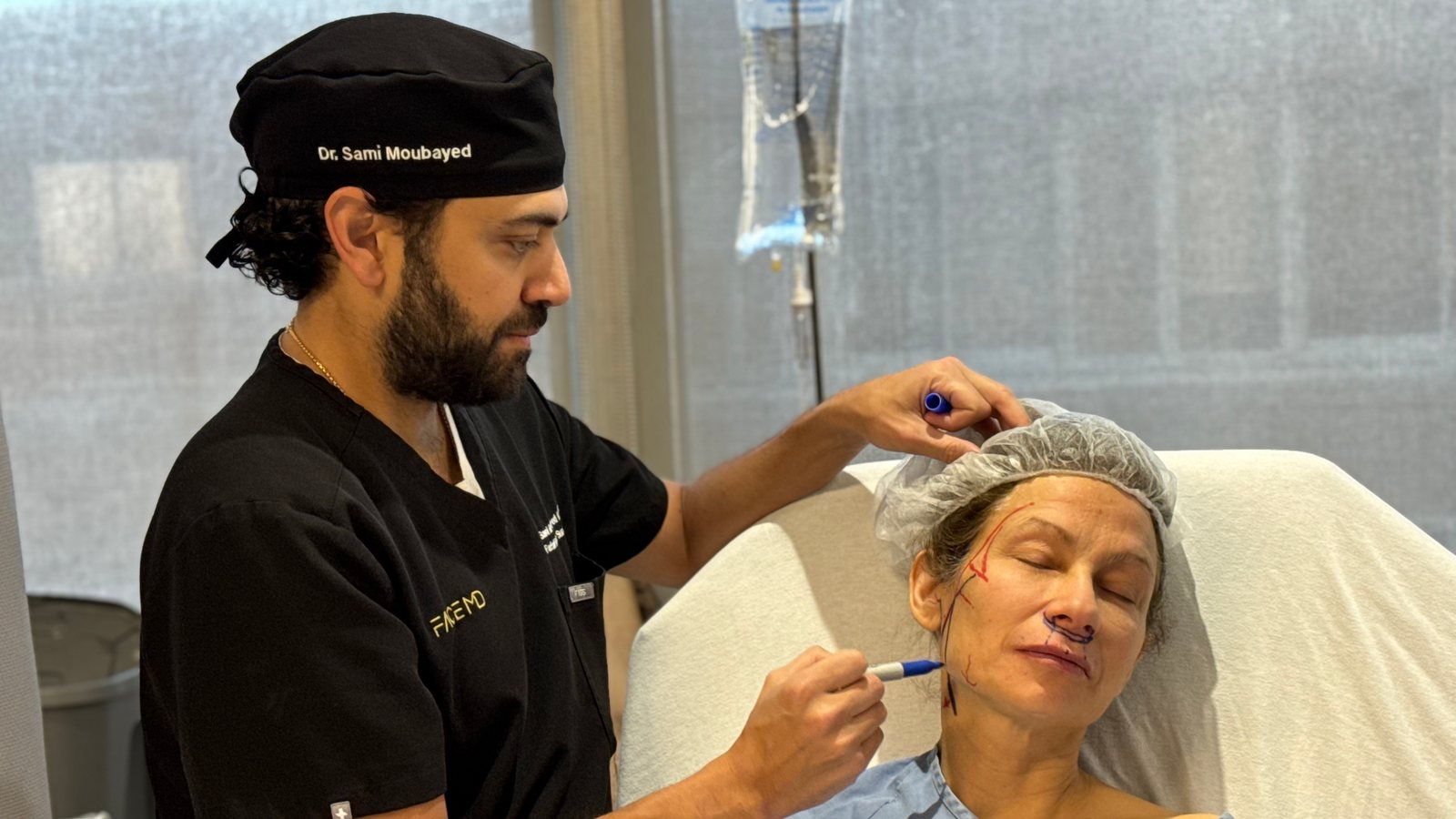
There is a lot of talk about the deep plane facelift. After more than ten years in practice, Dr Moubayed, an otolaryngologist – head and neck surgeon practicing facial plastic surgery, is convinced that the result does not depend on the technique’s name alone. It comes from a series of specific steps, chosen for each face, that refine the outcome.
What is a deep plane facelift?
In a deep plane facelift, the skin is lifted only in a very limited area near the ear. A few centimetres in front of the ear, the dissection goes deeper: under the platysma muscle in the neck, and under the SMAS in the face. Surgeons still debate the names and variations, but the principle is the same: the work is done with a deeper flap.
The face has ligaments that attach the skin to the deeper layers. They keep the tissues from moving up properly. Releasing them allows the face to be repositioned higher, rather than simply pulling the skin tight, which helps the result look natural. Learn more on our deep plane facelift in Montreal page.
Aging is not only about sagging
With age, tissues move downward, and a facelift helps lift them. But the face also loses volume, including bone. The eye sockets hollow out, and the upper and lower jaws lose a little bone.
That is why Dr Moubayed likes to combine the deep plane with some fat grafting: “When I add a little fat grafting, I find the results are even better.” Lost volume is replaced with the patient’s own tissue, in a measured way, so the face looks refreshed rather than filled. See our facial fat transfer page.
The glands and the jawline
Two types of salivary glands affect how the neck looks: the parotid glands, just in front of the ear, and the submandibular glands, under the jaw. Over time, they descend. Even after the face is lifted and the platysma is resuspended, two small bulges can remain under the jaw.
In appropriate cases, slightly reducing these glands helps create a cleaner jawline, and Dr Moubayed finds that many patients benefit from it. He may also inject a neuromodulator into the glands to lower the risk of a saliva leak after surgery. This decision is always made in consultation, after an examination.
The neck: the “platysma sling” technique
When the deep plane is extended into the neck, Dr Moubayed uses a technique published a few years ago, the “platysma sling.” He compares it to a hammock that resuspends the neck from one ear to the other. The two bones behind the ears are the posts, and the muscle forms the fabric in the middle.
For it to work, the suspension has to be solid, continuous and well shaped from one side to the other. A weak point anywhere along the line can compromise the result. He says this has been the most demanding part of his work in recent years. With facelift surgery becoming more widespread and results shared on social media, patients and surgeons can now see many outcomes, along with the small refinements that can make a difference. Each of these refinements is chosen for the individual patient, not applied to everyone the same way. For details, see our deep neck lift page.
Don’t forget skin quality
Tissues can be lifted and volume restored, but the skin also changes with age: less hydration, more wrinkles, sun spots and sun damage, some laxity. “You can’t rejuvenate the shape without rejuvenating the texture and the colour of the skin.”
Resurfacing techniques such as CO2 laser or some peels address this. Dr Moubayed also mentions other possible additions, such as PRF under the skin to help it adhere to the deeper tissues. Depending on the face, a facelift can also be combined with a brow lift, eyelid surgery, a lip lift or a chin implant.
Every procedure carries risks and requires a medical consultation to decide what suits your situation. To talk it over with our team, book a free 30-minute discovery call. Clinique Face MD, the place for my face.